In recent months, I’ve found myself unexpectedly emotional while developing resources for the Cancel Loneliness campaign. This is a community activation project I’ve had the privilege to lead through my work with local charity Band of Brothers Qld Inc.
It wasn’t until I started writing phone educational guides and designing posters and invitations to encourage people to notice signs of loneliness with their own peers and family that I realised… I was describing my own needs too.
A lot of people assume that if you’re visible and active in your community, you must be thriving socially. But the truth is, loneliness doesn’t always look like isolation. Sometimes it looks like a full calendar and a very quiet house.
I’ve been running a business on my own for years now. That decision brought freedom, flexibility and purpose, but it also took me away from something we often don’t realise we need: regular human connection. Gone were the spontaneous kitchenette chats, team drinks, staffroom lunches & sneaky ciggie breaks, as well as shared celebrations and frustrations of working life.
Add to that a husband who travels extensively for work, adult children who’ve moved out, and a remote-work lifestyle, I began to realise how much of my daily life was happening in solitude.
That’s part of why I started The Ocean Network, and later Ladies Who Long Lunch. These communities weren’t just business strategies – they were lifelines. Quiet acts of courage to reach out and build spaces where connection could bloom again.
Now, leading the Cancel Loneliness campaign, I’ve poured those same emotional drivers into every asset we create:
Every one of these materials is grounded in the idea that moments matter –the theme for this year’s Loneliness Awareness Week, about the small act of reaching out, which can be the difference between someone feeling invisible and someone feeling seen.
Sometimes when I read back through the copy we’re printing or listening to stories from my own peers who have mustered up the courage to share their similar stories, I tear up. Because I know – firsthand – how powerful it is to feel that someone remembers you, and that you’re not alone.
It’s not just me. According to the current data, nearly 1 in 3 Australians report feeling lonely – and those numbers are rising. Loneliness doesn’t discriminate: it affects the elderly, the young, carers, remote workers, single parents, new residents, and yes, even campaign designers.
We can’t solve loneliness overnight. But we can take action.
We can notice who’s missing from the table.
We can gently reach out.
We can name loneliness for what it is, and we can guide people toward connection and reconnection.
And maybe… just maybe… while helping others, we can begin healing our own hearts too.
Today my emotions have been set off again, as I received a note from the President of Band of Brothers Qld Inc. thanking me for all the work I’ve put in above the call of duty and how much he appreciates how I’ve helped make the Charity focus on what’s important and present something to the community that will not only be effective but a body of work they can take pride in.
We’re still a fortnight away from launching the campaign to the public, and so I have a lot of emotional moments to come I’m sure. But if you’ve ever felt the sting of loneliness, or know someone who has, I invite you to follow along with the Cancel Loneliness campaign.
You could share a message or story with me.
You could even want to know more about how your organisation could become an Advocate.
You might even like to learn how to recognise the signs of loneliness in others so you could refer them if it feels right.
So please reach out to me to help rewrite the story of disconnection, one conversation at a time.
Armed with over 20 years’ experience in the event management business, Kirsty Fields has co-ordinated everything from kids’ events to national sports games. After a successful career in sports, she embraced modern marketing and promotional techniques.
Her passion for training clients in social media, digital marketing and branding has been combined to present her multi-award winning business Social Ocean a bespoke events marketing agency.
Kirsty’s experience in event management and coordination, and the small business space, backed by her passion for marketing, makes her an ideal source for all things related to events, small business, marketing, social media and branding.
You can find a list of podcasts Kirsty has been featured on, on our About page.
Originally published in The Road Ahead Feb-Mar 2022 magazine. Written by Jessica Wilson.


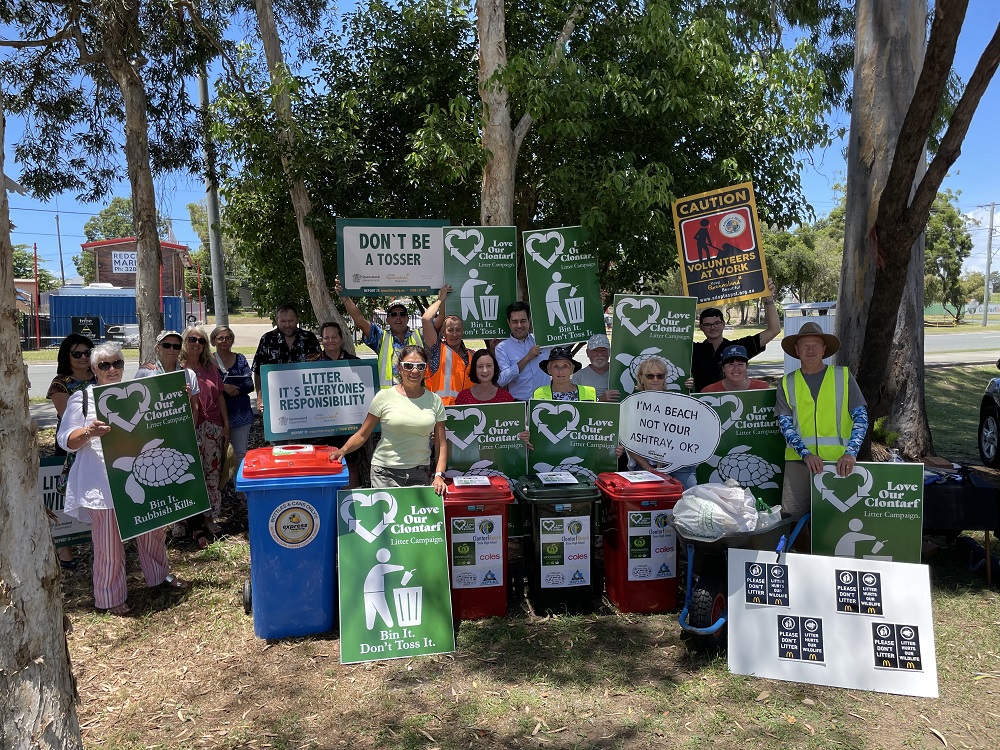
More than 2.8 tonnes of rubbish was collected by “Waste Warriors” in Clontarf (Ningi Ningi Country) as part of a 100-day program to reduce litter in the region. Love our Clontarf 100-Day Litter Campaign founder Les Barkla said the initiative was a community response to a growing problem.
“I have a Facebook community group called Pristine Peninsula and I noticed two of our Waste Warriors, Phil and Sue Johnson, were picking up a horrendous amount of fast-food packaging and other listter within a 2km radius of a fast-food chain,” Mr Barkla said.
“They were filling a 240-litre council rubbish bin a week with mostly takeaway packaging.”
Mr Barkla created the 100-day campaign with the support of Waste Warriors, the community, local, state and federal governments and local businesses.
“The Redcliffe Peninsula is a unique area as we’re 80 percent surrounded by water, so all the litter on streets ends up in Moreton Bay or Hays Inlet, which is a very sensitive ecosystem for turtles and dugongs,” he said.
“We designed the campaign to bring about education, awareness and behavioural change around litter and actually keep it out of our waterways.”
More than 100 volunteers participated in the campaign which focused on litter hotspots including Snook Street, where the fast-food chain is located, and the Clontarf Beach State High School.
“Local businesses sponsored electronic message boards with anti-littering messages. We had quite effective roadside sign vigils and 40 street sponsors cleaning up their local streets,” Mr Barkla said. The result was a 45 percent reduction in rubbish during the 100-day period and more than 15,000 litter items diverted from local waterways.
“On Snook Street alone, we picked up nearly 11,000 pieces of littler over the 12 weeks,” Mr Barkla said.
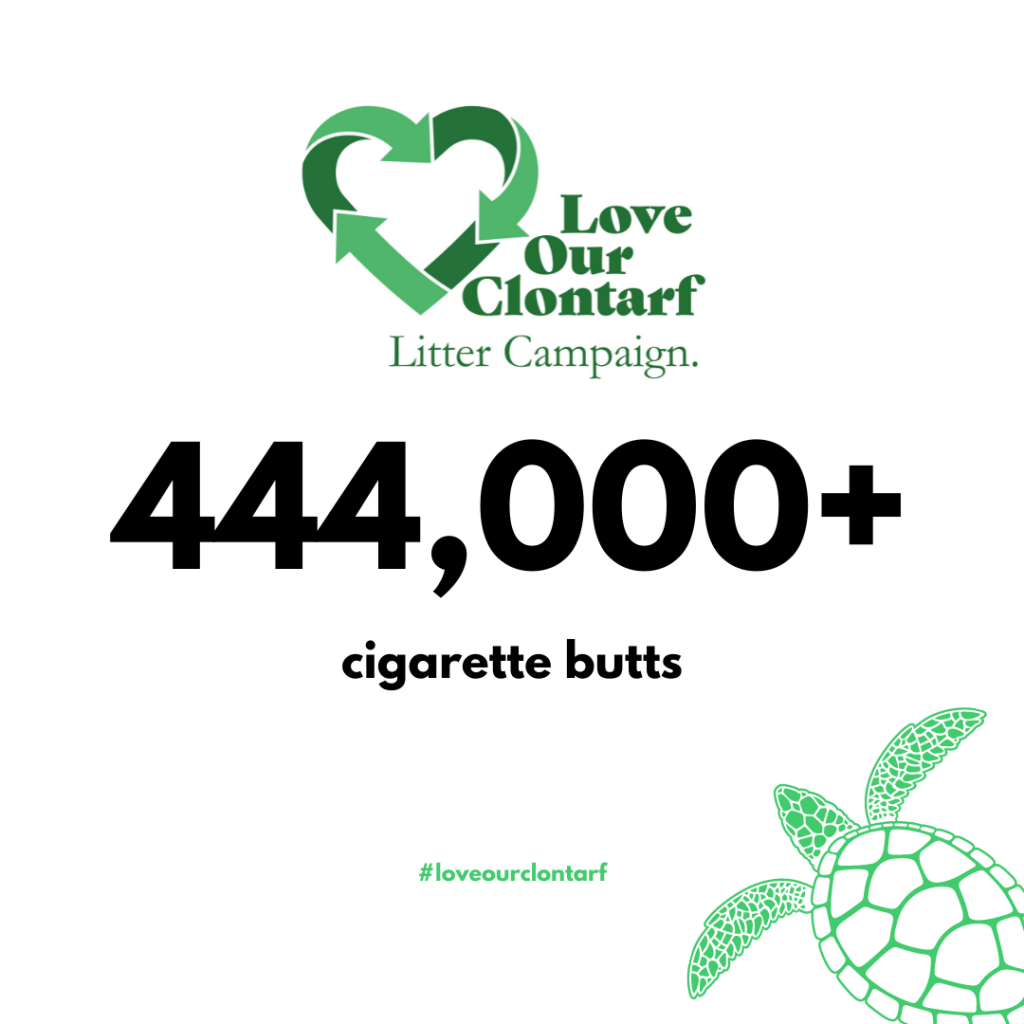
“The major items we picked up were 4,500 cigarette butts, which is a major issue for roads, followed by fast-food packaging.”
Mr Barkla said people who threw litter from their vehicles rarely saw the impact of their actions.
“They think their one cigarette butt won’t make a difference and don’t understand that it will take five to 10 years to break down,” he said.
“When you equate what we picked up on Snook Street to annual period, it’s about 50,000 pieces in just 1.6km stretch of road.”
Mr Barkla said the fight against litter was ongoing despite the campaign’s success.
The campaign doesn’t end now the 100 days are over and we’re putting pressure on the government to actually make changes,” he said.
“All packaging needs to be 100 percent compostable or it’s not going to get better because a litterer doesn’t care whether an item is made from recycled material, they just throw it out the window anyway.
“We’re just a community of 60,000 people and just a small part of the state, but I’m a strong believer in communities driving change.”
Read the report here.
Join the Pristine Peninsula Facebook Group
Follow the Pristine Peninsula Redcliffe Facebook page
See how Social Ocean supported the Love Our Clontarf Campaign
 The Love Our Clontarf 100 Day Litter Campaign, undertaken on the traditional lands of the Ningy Ningy people, was a litter baseline study and litter reduction campaign held across 100 Days at the beginning of 2021.
The campaign focused on a targeted litter hot spot in a 2 kilometre radius of the McDonalds Clontarf, Redcliffe Peninsula.
At the campaign launch in January, acknowledgement of the Ningy Ningy Peoples – the traditional custodians of the land on which we gathered – was made by campaign Founder Les Barkla. Paying respects to our Elders past, present and emerging, Les also stated that this campaign was all about respect for this land and these local waters, as the ancestors cared for them for 20,000 years.
The Redcliffe Peninsula won numerous Tidy Towns Awards in the early 2000s. Today that level of respect has been lost, as has the connection with land and waters. This has been backed by statistics showing 8 billion cigarette butts are littered every year and 8 million litter items are tossed every day in Australia (Keep Australia, 2019).
Providing raw data to show stakeholders that littler is a serious terrestrial and marine environment issue for this littler hot spot and for the Redcliffe Peninsula. Redcliffe is surrounded by 80% waterways with sensitive marine ecosystems and official Marine National Parks.
Litter was reduced by 45% at the Snook Street audit site over the 12 weeks of audits using various litter awareness and education strategies including social media campaigns, digital sign board located at the audit site, campaign signage around the area, local media coverage with sharing of online content by key stakeholders.
If adequate litter enforcement strategies and resources were available, these 10,952 litter items would have potentially brought in $2.8M in fine revenue based on the now current minimum Litter Fine of $275 (risen in price at 1 July 2021).

The Love our Clontarf 100 Day Litter Campaign Final Report (click to download) includes:
Delivery and discussion with Moreton Bay Regional Councillor Karl Winchester (Division 6 Councillor for Clontarf), meeting attended by fellow area Councillor Sandra Ruck,
Delivery and discussion with State Member for Redcliffe, Yvette D’Ath MP,
Delivery and discussion with Federal Member for Petrie, Luke Howarth MP.
Stencilled footpath messaging for concrete walkways around the Redcliffe Peninsula designed and delivered by the Moreton Bay Regional Council Environment Team. Installation commenced December 2021 with further roll out due in the in the first quarter of 2022.
“Community-Driven Campaign Calls for Action on Litter” by by Jessica Wilson – RACQ Road Ahead Magazine, Feb/March Issue 2022
2021 Community Spirit Awards Finalists by ABC Radio Brisbane Community Spirit Awards – 8 November 2021
“Keeping Clontarf clean, one item at a time” by ABC Brisbane Breakfast Broadcast – 26 October 2021
“Report calls for action on litter” by Kylie Knight – 8 September 2021
“Labour of Love” by Kylie Knight – Dolphins News, 15 May 2021, page 19
“Fight to stop littering goes on” by Kylie Knight – Dolphins News, 5 May 2021, page 2
“Students join war on waste” by Jodie Powell – 14 April 2021
“100 Day campaign to reduce litter begins” by Kylie Knight – 29 January 2021
Join the Pristine Peninsula Facebook Group
Follow the Pristine Peninsula Redcliffe Facebook page
See how Social Ocean supported the Love Our Clontarf Campaign
Did you know indoor plants create healthy environments where people flourish? Many people enjoy living and working in green spaces, and like having indoor plants around. But is there more to it?
The answer is – YES! They look amazing! And there are many proven scientific health benefits about indoor plants. Here’s what research tells us about some of the benefits living and working with indoor plants.
They are natural air-filters! Plants absorb harmful toxins in the air while releasing oxygen into the workplace.
A cleaner more invigorating work environment will lead to better employee health.
Even if you love where you work, sometimes stress is unavoidable! University of Sydney (UTS) research found that offices experienced the following benefits:
One of the Fab 5 indoor plants may turn out to be the best cubicle-mate you’ve ever had. Many studies have found that plants in the workspace increases productivity and creativity.
And creative blocks are no joke! Whether you’re out of ideas or stuck on the same one for a little too long, office plants can provide inspiration.
Did you know that 50% of employees have no natural light in their place of work?
Also, one in five people said they have no natural elements in their office, whatsoever.
That means that a lot of us are working in a dark, lifeless space, which if you ask me, doesn’t seem like an appealing place to be.
That’s why there is an upward trend of potential employees taking the physical space into consideration when searching for new opportunities.

Surround yourself with plant wellness and go green in your workplace! Why? Because they are a great investment!
But, I can hear you say: What if I don’t have a ‘Green Thumb’? How do you know which plants will survive? Which plants are best for me and my workspace? You most likely don’t have an indoor plant expert beside you! So I’m here to help you choose the right plants to freshen up your office space.
Here are the ‘Fab 5 Indoor Plants’ that will make you the envy of your colleagues once installed in your office.
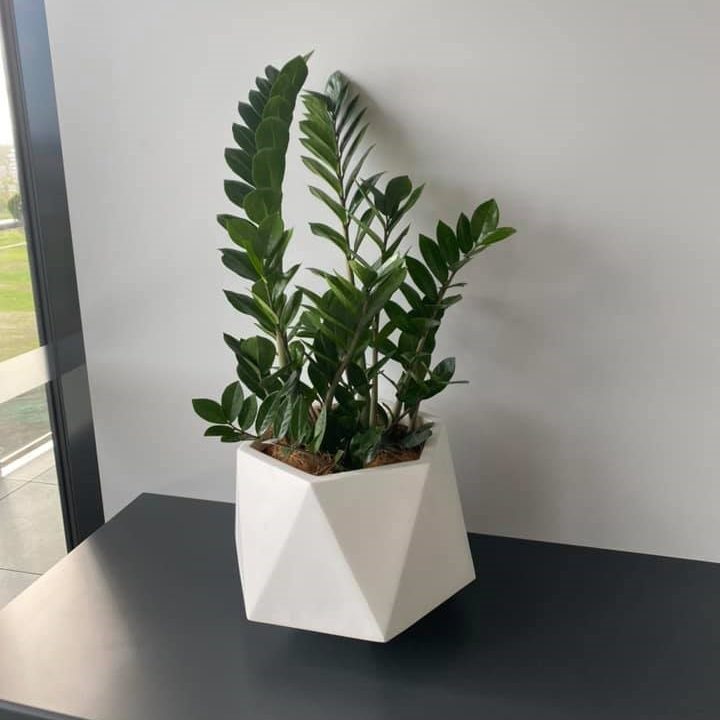
(Botanical name: Zamioculcas zamiifolia)
Almost the perfect plant. Tolerates low light, low water and even drought. You can neglect this one and it will still bring you joy by always looking healthy.
Often known as the ‘clean air plant’, the Zanzibar Gem is the perfect office plant, for work or home.
To keep it contained for any space, prune it. But, if left to its own resources; it will spread its wings, filling a much larger space than the top of the planter pot.
Keep this one dusted so the foliage is able to show off its beautiful shine.
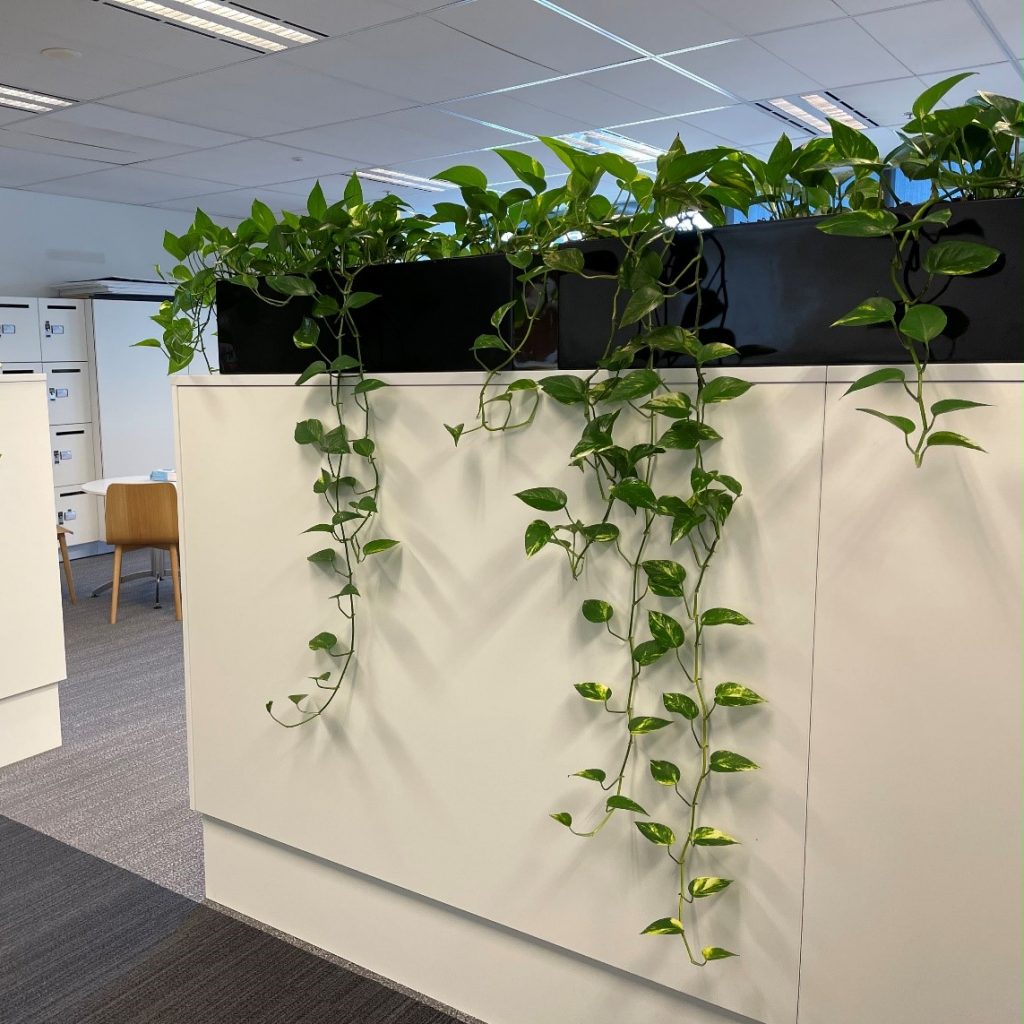
(Botanical name: Epipremnum aureum)
The Pothos Ivy has three main varieties. ‘Golden Pothos’, the ‘Neon Pothos’ and the ‘Marble Queen Pothos’.
Lack of airflow does not affect them much and so they thrive in indoor spaces. They also live for a long time without the need for high light.
The more light they have, the more water they will need. So keep them away from strong light (window or artificial) and they will be easier to maintain indoors.
Their colour will change into a dark greenish shade with less light.

(Botanical name: Sansevieria trifasciata)
Also called ‘mother-in-law’s tongue’. It is a sturdy and bold spiky looking plant and requires very little maintenance.
It tolerates low humidity, low light and low water.
There are over 70 varieties, but the most common are:
‘Superba’, ‘Golden Hahnii’ and ‘Sansevieria Twist’. All come in various sizes and are slow growing.
This indoor plant puts up with any environmental condition you can dish out! Don’t overwater this one.
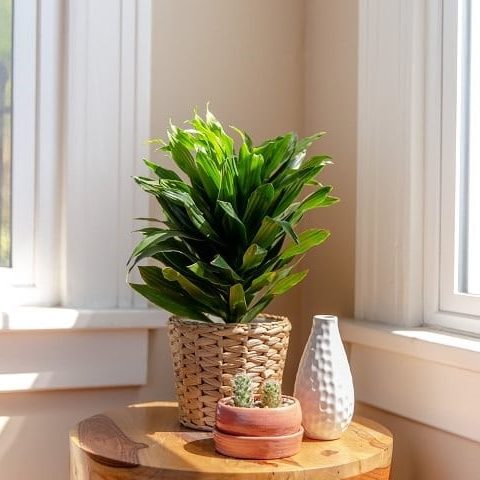
(Botanical name: Dracaena deremensis)
Janet is a great girlfriend to have. She adapts beautifully to any office or home conditions. With her dark green cluster of strappy foliage and is naturally shiny and lush. Its cane-like stem structure can also be propagated without the need for roots.
Keep the leaves clean by wiping them off with a damp cloth. Janet Craig poses as a remarkable office plant and you should invite her to move in with you right away!
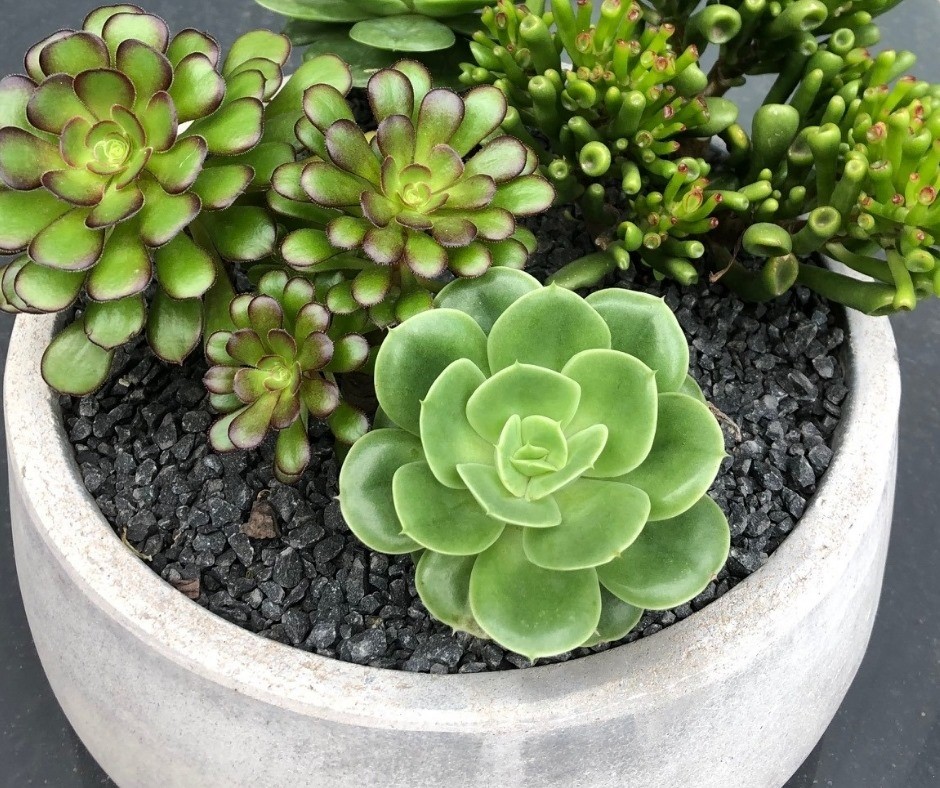
There are too many varieties to list here, so I will give you the general rules about keeping succulents. They are a desert plant, which thrives on sun and little water.
So do not try to keep a ‘cute’ succulent on your desk if there is no direct sunlight reaching your plant. No need to overwater, a small amount every month should do it.
‘Now you know about the Fab 5 fine-looking, almost no effort indoor plants. Go and surround yourself with plant wellness and go green in your workplace. It’s worth the investment’!

Special thanks to Guest Blogger Elaine Tunn. Elaine is the CEO of Interior Plantscape Association (IPA) and has kindly written this article for publication on the Social Ocean blog. The IPA is a professional association representing the growing indoor plant hire and maintenance industry across Australia and New Zealand.
If you need assistance from an indoor plant expert, reach out to one of the IPA members or the association directly via the links below.