Guest blogging is one of the most underutilised — and often misunderstood — tools in a marketing strategy. Done well, it’s not just about “getting your name out there.” It’s about borrowing trust, whilst expanding your audience, and building brand authority in spaces where your audience is already paying attention.
But there’s a catch: Guest blogging only works when you treat it differently from your own content. As people passionate about the variety of content you can create to show up, we’ve explored some items for you work through to optimise your process.
Here are 7 guest blogging tips to help you blog properly, and strategically.
The biggest mindset shift in guest blogging? You’re not creating content for your business, you’re contributing to someone else’s audience.
That means:
This is an important understanding and what will help you make a strong guest blogging strategy work.
Note: If you like exploring different styles of content, and would like to change up the tone or level of serious-ness from your own blogs – this is your opportunity.
If you’re serious about guest blogging for business, this is essential.
Your content should always be published on the host platform first.
Why this matters:
One of the biggest benefits of guest blogging is visibility, and your bio plays a key role. As part of the decisions around your contribution, ask:
Your author bio is where a guest blogging opportunity turns into lead generation.
Note: We almost always decide against guest blogging opportunities if an author bio is not included.
A strong content marketing strategy doesn’t stop at publishing. Once your guest blog goes live, share it across:
This amplifies reach and reinforces your authority.
Creating a publishing process of the guest blog through your channels is also providing a service back to the publisher to increase the level of visibility you’ll have or get back from them.
Guest blogging can strengthen your personal brand, especially on LinkedIn. Adding your article to your profile:
This is a simple but powerful step many business owners overlook.
Yes, you can reuse your guest blog content — but timing matters.
Best practice:
This protects SEO while still supporting your long-term content marketing strategy.
Not all guest blogging opportunities are equal.
Before saying yes, consider:
The right guest blogging opportunities will:
When used effectively, guest blogging can:
Guest blogging isn’t about creating more content. It’s also not just about visibility, it’s about credibility with your curated and thoughtful content. It’s also about being marketing savvy by broadening your own audience with the assistance of another network.
Being intentional with where your content lives and how it represents your brand is clever, and is a powerful way to grow your business… by showing up well, in someone else’s space.
Artificial Intelligence has changed website design forever, and I genuinely believe that’s a good thing.
As someone who designs, audits and rewrites websites for small businesses, I’ve embraced AI as part of my own workflow. It helps me research faster, explore ideas, challenge assumptions and analyse content in ways that simply weren’t possible a few years ago.
But one recent website redesign reinforced something that’s becoming increasingly clear.
AI is incredibly good at creating content. It still needs human strategy to create a great website.
When More Content Creates More Confusion
A business approached Social Ocean after investing significant time using AI to generate a brand-new website. The content itself wasn’t poor quality. In many places it was informative, well-written and technically accurate.
The problem wasn’t with what the AI system used had written. The problem was that the website had become enormous.
Every page wanted to explain every service in minute detail. Topics overlapped, messages competed for attention and the customer journey became increasingly difficult to follow. Instead of helping visitors make decisions, the website was asking them to process far too much information before they even knew where to begin.
Rather than trying to edit hundreds of individual sections, we made the decision to step back and rethink the website from the ground up
Returning to the Customer Journey
The first question wasn’t, “How can we improve the copy?”
It was, “How do customers actually use this website?”
Someone needing an emergency repair has very different priorities to someone researching a new garage door. Another visitor might simply be comparing insulation options, while someone else is looking for compatible door openers.
Those people shouldn’t all have to navigate the same overwhelming page.
Once we understood the different customer journeys, the website structure almost redesigned itself.
Large, competing pages became focused service pages. Navigation became simpler. Calls to action became clearer. Instead of trying to rank one page for every possible search term, each page was given a single purpose and a much clearer message.
Less Content. Better Communication.
One of the biggest surprises was how little information we actually removed.
Most of the original content remained.
It was simply reorganised, rewritten and relocated so visitors could absorb it naturally instead of feeling overwhelmed by it.
The finished website contained many of the same ideas but presented them in a way that was easier to understand, easier to navigate and far more helpful for both visitors and search engines.
Sometimes good website design isn’t about writing more. But it is about helping people find what they need more quickly.
Building Strong Foundations
With the new structure complete, attention turned to the technical foundations that support a successful website.
We reviewed page titles, heading structure, metadata, internal linking, local business information, XML sitemaps, indexing, image optimisation and page performance. These aren’t the parts a website visitor ever notices, instead they create the foundation that helps search engines understand your business while improving the experience for your customers.
Interestingly, this stage also demonstrated another strength of AI. Throughout the project it assisted with audits, reviewed content structure, questioned SEO decisions and helped test ideas. Rather than replacing experience, it became another valuable tool in the decision-making process.
Technology Doesn’t Replace Strategy
Working through this project reinforced something I’ve believed for a long time. AI isn’t replacing good website designers, it’s actually making good website designers even better.
Technology can generate ideas, write first drafts, analyse pages and identify opportunities for improvement at remarkable speed. What it can’t do is understand your customers the way an experienced strategist can.
It doesn’t always know which message should come first. It doesn’t recognise when two pages are competing with each other. It also can’t tell when a visitor is becoming confused, or when a call to action appears too early – too late – or too many times!
Those decisions still rely on human judgement, business experience and an understanding of how people actually behave online.
Plus, it can’t account for client specific requests to override any or all of these.
The Human Experience Is Still the Most Important Part
At Social Ocean, every website starts with a simple question: “What does your customer need to do next?”
That question influences every decision we make. It shapes page structure, navigation, copywriting, layout, what the calls to action are, and ultimately the success of the website itself.
Search engines continue evolving because they’re trying to better understand human behaviour. The websites that perform well are usually ones that make life easiest for the people using them – and are clear with the way information is presented.
That’s why user experience remains one of the most valuable parts of website design. It isn’t just about creating something that looks professional. It’s about removing friction, creating confidence and helping visitors find exactly what they came looking for.
Currently, some of the worst websites we see have been built by AI. Especially in terms of visual presentation and customer navigation.
In future, websites will be built better by AI as it continues to evolve. But we can’t see the future of websites being built by AI alone. They’ll be built through collaboration – combining the efficiency of technology with thoughtful human strategy, creativity and experience. That’s exactly where Social Ocean sits.
We embrace AI. We use it every day. But we never let it make the decisions that matter most. Because websites aren’t built for artificial intelligence. They’re built for people.
Buying a business is a major milestone, but for many new owners, social media quickly becomes one of the most confusing and stressful parts of the transition.
If you’ve purchased a business and found yourself locked out of Facebook or Instagram, unsure who owns the Meta Business Manager, or overwhelmed by requests for logins, permissions, or two‑factor authentication, you’re not alone. Social media ownership issues are one of the most common – and least anticipated – problems new business owners face after settlement. Especially when we see the business we’re buying have high/successful Follower counts!
At Social Ocean, we regularly support new business owners across Australia – including Redcliffe and the Moreton Bay region – to recover, untangle, and properly secure their social media and Meta business accounts so they can move forward with confidence.
When a business changes hands, its digital assets don’t always transfer cleanly. Especially with social media.
We frequently see situations where:
What looks like a “simple login issue” often turns out to be a structural ownership problem that requires careful recovery and verification.
Over the past year, Social Ocean has assisted multiple new business owners – each with very different social media access challenges.
In one case, issues stemmed from a combination of simple setup errors and limited communication during the sale. As a result the new owner started renaming existing accounts after rebranding without understanding the importance of naming conventions, created duplicate social accounts by accident and got tangled up with syncing issues between wrong/right accounts and platforms. By mapping the accounts out, and identifying ownership and access of each was integral to the final solutions.
In another, the business had been granted access through multiple pathways over time. Initially though the new owner didn’t understand how Meta permissions, security checks, and two‑factor authentication worked together across multiple email accounts and dashboards. It made the process feel overwhelming and impossible to finalise – so it had been left only partially completed. Another team member had successfully gained Business account ownership, but the owner themselves were lacking overall ownership and access, leaving them vulnerable.
In a third situation, access to the Meta Business account had been left with a junior staff member when the business was sold. This left new owners unable to access and transfer correct ownership at all, which meant they couldn’t properly access to manage or own their own Meta assets. Using a business email login was the only way to log in with the lowest editing access option and they were left with complete inability to schedule anything.
And another business, the accounts had been hacked.
Each scenario required a tailored approach — but all shared one thing in common: the new owners had inherited systems that were never designed for clean ownership transfer. And over the years, the variety of problems we’ve assisted with is even more vast.
Your social media accounts are not just marketing tools, they’re business assets.
Without proper ownership and control, your business may be exposed to:
Ensuring your Meta Business Manager and social media accounts are correctly owned, secured and documented protects your business now and makes future growth, staffing and succession far easier.
Based in Moreton Bay, Queensland and supporting clients across Australia, Social Ocean specialises in supporting new business owners through social media and Meta account recovery by:
We translate complex systems into plain English and provide calm, practical support at a time when business owners are already juggling a lot.
Bought a Business and Unsure Who Owns the Social Media Accounts?
If you’ve recently purchased a business – or are in the middle of a transition – now is the time to make sure your social media and Meta accounts are properly set up and fully under your control.
If you’re in the middle of a transition, our advice is to complete handovers prior to the end of communication with the Seller, in the presence of the Seller or their representative. It’s not good enough to trust the Seller when they say, “Yes – it’ll be done for you, no problem”, because business owners aren’t necessarily equipped with the skills to know how to help complete the process.
Social Ocean supports new business owners across Australia, including Queensland and the City of Moreton Bay, to transition access, secure ownership of the Meta accounts and move forward with confidence.
Get in touch with Social Ocean today to discuss social media and Meta Business account access support.
There’s no denying it – Squarespace websites are pretty.
They’re clean, fluid and stylish straight out of the box. The modern layouts, smooth scrolling effects, and clever use of white space give the impression of a professionally designed site even when they’re built from templates.
As a web designer, I get it. I’ve admired these visual effects – especially the way images fade in, and how fonts glide and curve across pages, and how easy it is to make something look instantly polished.
But beneath all that visual appeal lies a reality most business owners don’t realise until much later: Squarespace’s beauty comes at the cost of performance and control.
And when a business needs more than a digital brochure – if it needs a fast, findable and flexible website that grows with your goals – you’ll quickly run into limitations.
So if a business owner comes with a request to me to build them a Squarespace site, I wouldn’t say yes. What I would do, is explain why that shouldn’t be their choice of website builder, and help them to understand that performance over visual trends will always be better.
Here are the three biggest issues I’ve experienced time and time again, when clients with existing Squarespace sites come to me for help.
Squarespace sites are often slower to load than those built on WordPress or Wix. That’s because the platform uses a shared hosting environment. This means your site runs on the same server setup as thousands of others, with limited optimisation options.
You can’t add speed-enhancing plugins, compress images beyond their defaults, or fine-tune caching and CDN settings. It’s all locked behind the platform’s walls.
Even the most beautiful website loses its shine if visitors leave before it loads. Google research shows that users start dropping off after just three seconds on a site that loads slowly, and site speed directly affects your SEO ranking.
By contrast:
WordPress lets you choose your own host, optimise images, and install performance plugins.
Wix has improved dramatically, with automatic image compression and built-in caching.
Squarespace? It looks good, but moves slow.
Squarespace is built for simplicity. It’s why it’s been popular with “designers” who value visual over performance, or lack in website development awareness. This simplicity limits your ability to fine-tune important SEO and performance settings.
It also flags to us that your designer, may not have digital marketing skills.
If you want to adjust or customise technical settings like:
Custom schema markup (This helps search engines understand what your content is (product, event, article, review) and display it attractively in results with rich snippets that boost click-through rates).
The robots.txt file (This tells search engines which pages to crawl and which to skip. Managing this ensures only your best, customer-facing pages appear in search results).
XML sitemaps (This acts as a road map to help Google find and index your pages faster especially new content and blog posts).
Canonical tags (Prevents duplicate content issues by telling Google which version of a page is the “official” one).
These small but powerful tools make a big difference in how your site performs in search engines.
Squarespace automatically creates them for you – but doesn’t let you edit or refine them. That means your SEO strategy is stuck at the beginner level, no matter how strong your content is.
By contrast:
WordPress gives you full control with plugins like Yoast SEO or Rank Math.
Wix provides structured data options, meta tag editing, and sitemap controls right in the dashboard.
Squarespace’s “locked box” approach is great for beginners, but frustrating for anyone ready to grow.
Squarespace offers a handful of SEO basics — like editing page titles, meta descriptions, and URLs. That’s fine for getting started, but advanced SEO needs more.
Here’s how Squarespace compares with Wix and WordPress when it comes to SEO tools and flexibility:
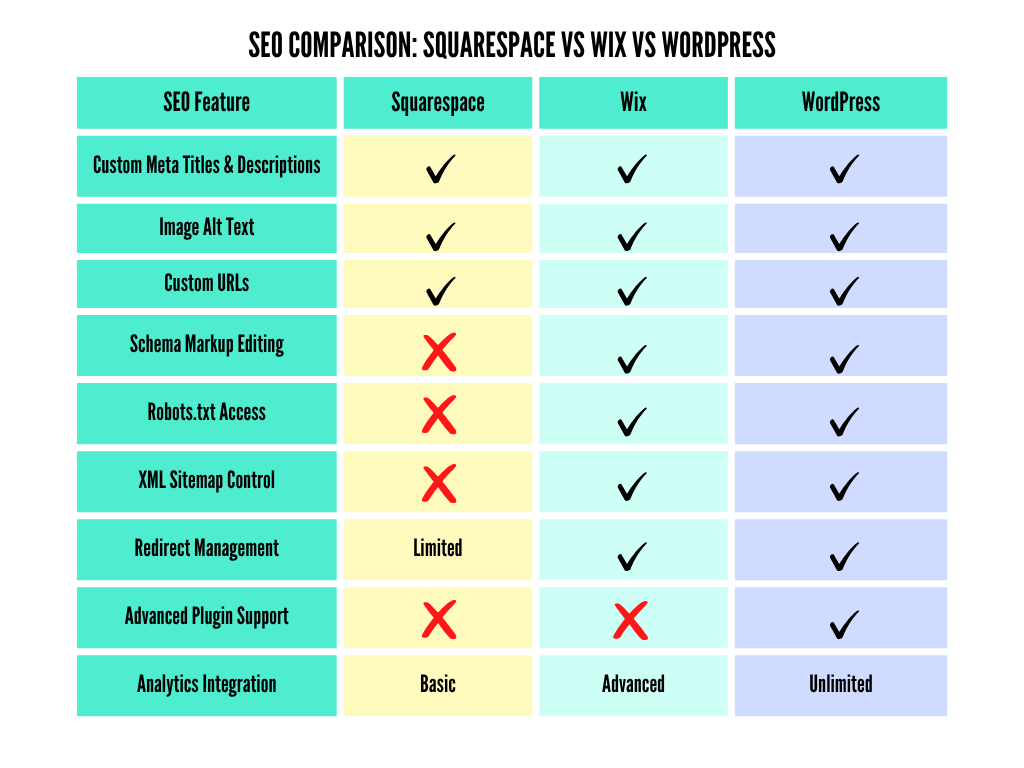
Squarespace covers the essentials, but it doesn’t scale well when your marketing strategy becomes more data-driven. WordPress and Wix both provide the depth and adaptability needed for businesses that care about long-term SEO results.
Squarespace wins on style, but WordPress and Wix win on substance.
If you’re running a small creative business or a simple online portfolio, Squarespace can be a great start. But when you’re ready to grow — to rank higher, attract more customers, and build a site that performs as well as it looks — you’ll need a platform that gives you freedom, flexibility, and room to evolve.
Curious about the speed of your website? Run a check on your website via Google PageSpeed Insights. It will also give you a list of improvements to make across your site to help the users experience.
We’re updating several areas of our own site, and using this checking system to help keep us on top of our game too.
At Social Ocean, we create websites that are just as visually stunning as they are technically strong. Whether you’re ready to move on from Squarespace or want to optimise your existing site, we can help you design a platform that works harder for your business – fast, flexible, and built to be found online.
👉 Let’s chat about your next website. If you’re ready to move your website to a more powerful platform, our Design services might provide the solution.
Searching for a February 2026 social media calendar in Australia?
This month may be short, but it’s full of opportunities to connect with your audience. From Valentine’s Day to World Cancer Day, there are plenty of occasions that help you balance meaningful awareness content with lighter, fun moments. Social media dates are a quick way to reduce the stress of planning, while keeping your feed fresh.
Whether you’re a small business, a charity, or a content creator, planning ahead with a calendar like this will give you confidence. Scroll below for the complete list of February 2026 dates. We’ve given some additional context to some dates, as well as used others for prompts you could make your own.
Want to know how to use this month’s dates?
There are plenty of dates to help inspire you and balance out serious content with fun and quirky – yet still quality – ideas.
We’re often missing some fun and laughter within the seriousness of business or impactful charity work, and some of the dates found in this month could help with this. Read through the list of dates and pick out the ones that immediately make sense to your work. They’ll be easy to tie into your content planning. When it comes to well-known days across the year, an acknowledgement post might be obvious, but thinking outside the box could spark an entire blog or awareness piece.
💡 Tip for specialty industries: If you work in a trade or profession with an Australian governing body, it’s always worth searching for your industry’s specific awareness calendar as well. Those specialist dates aren’t included here, but they can be a goldmine for relevant, high-impact content.
Generating bigger, more substantial content brings more benefits than just showcasing thought leadership – it can greatly assist your website SEO, which Google loves! And when it comes to the fun stuff, take the lead and let those quirky dates spark creativity in your team too.
Remember, you don’t always need to include a sales push in every post. But if you can tie some of this month’s dates to your services or products, give it a crack. And if it all feels a bit whimsical, join a Social Ocean content creation workshop to build your confidence and upskill at the same time.
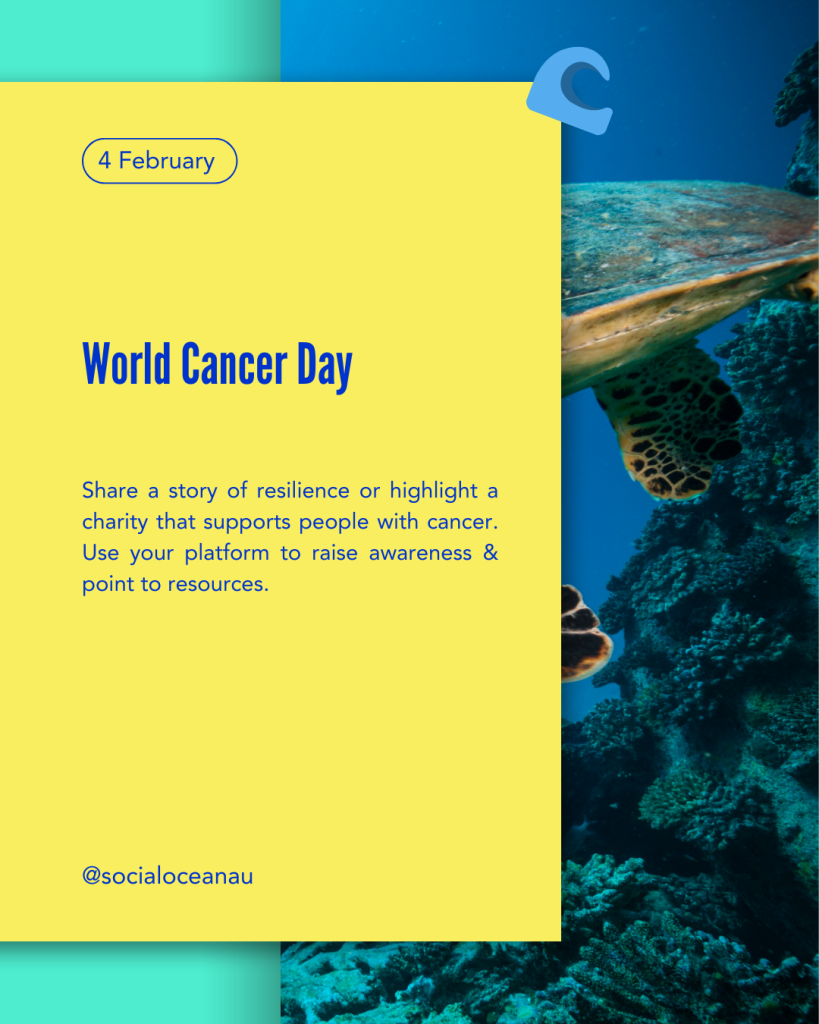
World Cancer Day (Awareness): Share a story of resilience or highlight a charity that supports people with cancer. Use your platform to raise awareness and point to resources.
Don’t Cry Over Spilled Milk Day (Fun/Quirky): Share a light-hearted ‘oops’ moment from your business journey and what you learned from it. Invite your audience to share theirs too.
Valentine’s Day (Awareness): Flip it business-style: post about what you love most about your clients, team, or community. Include photos or testimonials for extra warmth.
Need help turning awareness dates into actual content? Book into a Social Ocean workshop and we’ll show you how to build posts that engage, not just fill space. Plus, don’t forget to sign up to our newsletter for the monthly dates list direct to your inbox.
Searching for an April 2026 social media calendar in Australia? April ushers in autumn properly, with Easter often providing a major anchor for B2C businesses.
This month is full of opportunities for seasonal campaigns, thoughtful awareness days, and fun holidays like Grilled Cheese Day. Using a calendar like this will help small businesses, charities, and content creators strike the right balance between serious content and light-hearted engagement.
Scroll down for the complete April 2026 list. We’ve given some additional context to some dates, as well as used others for prompts you could make your own.
Want to know how to use this month’s dates?
There are plenty of dates to help inspire you and balance out serious content with fun and quirky – yet still quality – ideas.
We’re often missing some fun and laughter within the seriousness of business or impactful charity work, and some of the dates found in this month could help with this. Read through the list of dates and pick out the ones that immediately make sense to your work. They’ll be easy to tie into your content planning. When it comes to well-known days across the year, an acknowledgement post might be obvious, but thinking outside the box could spark an entire blog or awareness piece.
💡 Tip for specialty industries:
If you work in a trade or profession with an Australian governing body, it’s always worth searching for your industry’s specific awareness calendar as well. Those specialist dates aren’t included here, but they can be a goldmine for relevant, high-impact content.
Generating bigger, more substantial content brings more benefits than just showcasing thought leadership – it can greatly assist your website SEO, which Google loves! And when it comes to the fun stuff, take the lead and let those quirky dates spark creativity in your team too.
Remember, you don’t always need to include a sales push in every post. But if you can tie some of this month’s dates to your services or products, give it a crack. And if it all feels a bit whimsical, join a Social Ocean content creation workshop to build your confidence and upskill at the same time.
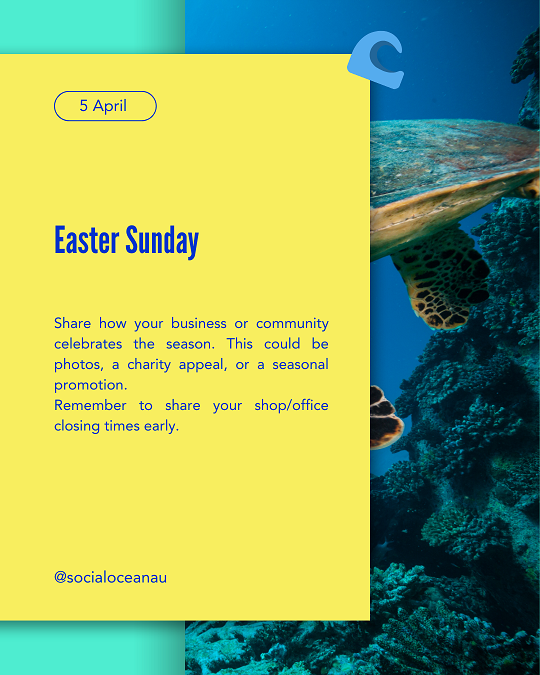
Easter Sunday (Awareness): Share how your business or community celebrates the season. This could be photos, a charity appeal, or a seasonal promotion.
ANZAC Day (Awareness): Create a respectful tribute post honouring veterans or resilience in your industry. Use appropriate imagery and tone.
Grilled Cheese Day (Fun/Quirky): Post a fun foodie snap and ask your audience: how do you like your toasted sandwich? Light-hearted and engaging.
April is a big month for B2C content. If you’d like to plan your social media around events like Easter or Earth Day, reach out to Social Ocean for content workshops and strategy sessions.
Looking for March 2026 social media dates in Australia? March marks the start of autumn and brings with it a mix of serious awareness days and fun, quirky holidays.
This month includes International Women’s Day and Harmony Day, both powerful opportunities to connect with your audience. It also includes International Day of Awesomeness and Mario Day, perfect for light-hearted content. For businesses and charities alike, a monthly social media calendar is one of the easiest ways to plan smarter and create engaging content.
See below for the complete March 2026 list. We’ve given some additional context to some dates, as well as used others for prompts you could make your own.
Want to know how to use this month’s dates?
There are plenty of dates to help inspire you and balance out serious content with fun and quirky – yet still quality – ideas.
We’re often missing some fun and laughter within the seriousness of business or impactful charity work, and some of the dates found in this month could help with this. Read through the list of dates and pick out the ones that immediately make sense to your work. They’ll be easy to tie into your content planning. When it comes to well-known days across the year, an acknowledgement post might be obvious, but thinking outside the box could spark an entire blog or awareness piece.
💡 Tip for specialty industries:
If you work in a trade or profession with an Australian governing body, it’s always worth searching for your industry’s specific awareness calendar as well. Those specialist dates aren’t included here, but they can be a goldmine for relevant, high-impact content.
Generating bigger, more substantial content brings more benefits than just showcasing thought leadership – it can greatly assist your website SEO, which Google loves! And when it comes to the fun stuff, take the lead and let those quirky dates spark creativity in your team too.
Remember, you don’t always need to include a sales push in every post. But if you can tie some of this month’s dates to your services or products, give it a crack. And if it all feels a bit whimsical, join a Social Ocean content creation workshop to build your confidence and upskill at the same time.
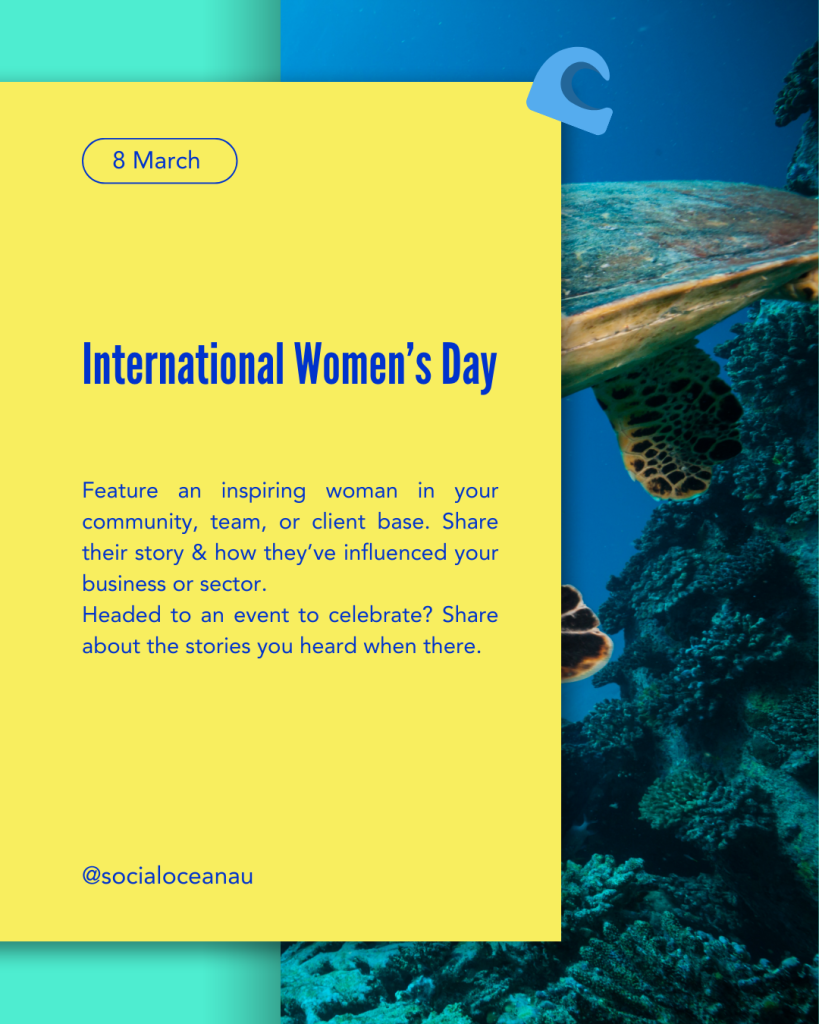
International Women’s Day (Awareness): Feature an inspiring woman in your community, team, or client base. Share their story and how they’ve influenced your business or sector.
Harmony Day (Awareness): Post about how cultural diversity shapes your work, audience, or events. Invite your community to share their own perspectives.
Mario Day (Fun/Quirky): Create a playful post with a ‘power-up’ theme: what gives your business a boost? Use gaming-inspired icons for fun.
Ready to plan your content with confidence? Join our newsletter to receive the Social Media Dates list every month, plus Ocean Network and Ladies Who Long Lunch events. Or chat to us about running a private workshop for your business or charity team.
Looking for a social media calendar for January 2026 in Australia? You’re in the right place. This month kicks off a fresh new year and is packed with opportunities for businesses, charities, and content creators to engage their audiences. A social media calendar helps you plan posts around public holidays, awareness days, and fun dates so your content feels timely and relevant.
January includes important occasions like Australia Day, as well as global observances such as Data Privacy Day. These dates are ideal for weaving in thoughtful messages, industry insights, or simple engagement prompts. For micro-business owners and charities managing their own marketing, using a calendar like this is one of the simplest ways to reduce stress and keep your content flowing.
Scroll through our full list of January social media dates below and start planning your month with confidence. We’ve given some additional context to some dates, as well as used others for prompts you could make your own.
Want to know how to use this month’s dates?
There are plenty of dates to help inspire you and balance out serious content with fun and quirky – yet still quality – ideas.
We’re often missing some fun and laughter within the seriousness of business or impactful charity work, and some of the dates found in this month could help with this. Read through the list of dates and pick out the ones that immediately make sense to your work. They’ll be easy to tie into your content planning. When it comes to well-known days across the year, an acknowledgement post might be obvious, but thinking outside the box could spark an entire blog or awareness piece.
💡 Tip for specialty industries: If you work in a trade or profession with an Australian governing body, it’s always worth searching for your industry’s specific awareness calendar as well. Those specialist dates aren’t included here, but they can be a goldmine for relevant, high-impact content.
Generating bigger, more substantial content brings more benefits than just showcasing thought leadership – it can greatly assist your website SEO, which Google loves! And when it comes to the fun stuff, take the lead and let those quirky dates spark creativity in your team too.
Remember, you don’t always need to include a sales push in every post. But if you can tie some of this month’s dates to your services or products, give it a crack. And if it all feels a bit whimsical, join a Social Ocean content creation workshop to build your confidence and upskill at the same time.
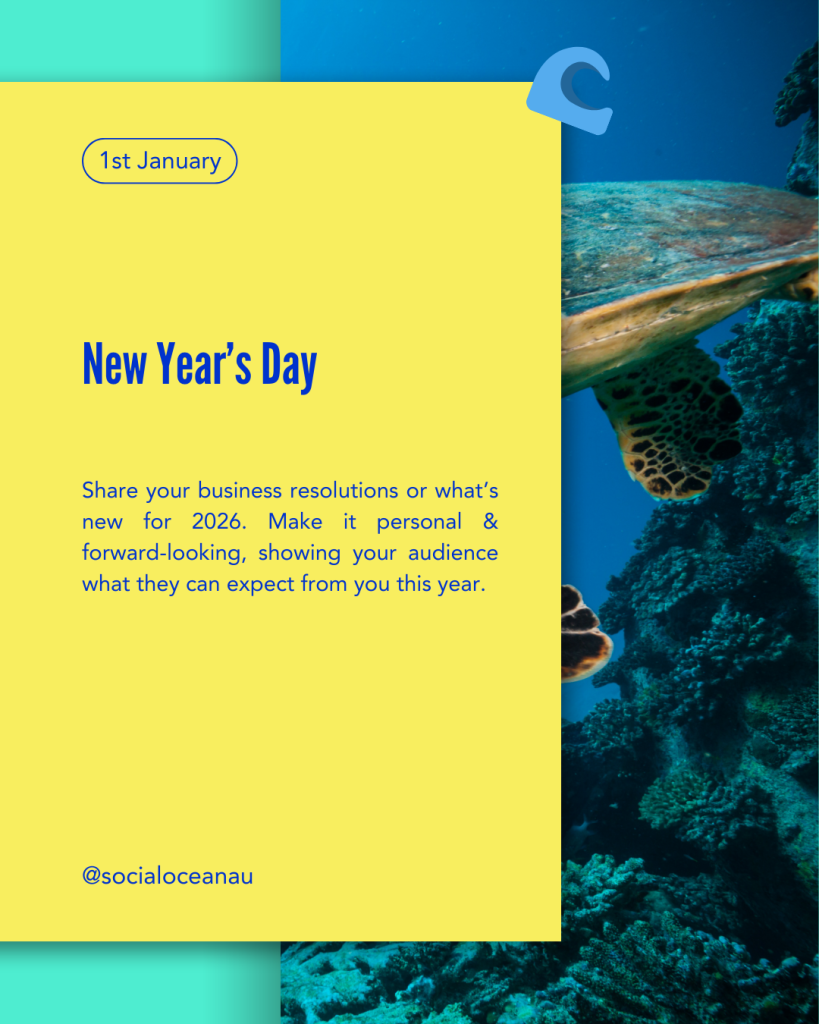
New Year’s Day (Awareness) – Share your business resolutions or what’s new for 2026. Make it personal and forward-looking, showing your audience what they can expect from you this year.
Make Your Dreams Come True Day (Fun/Quirky) – Encourage your audience to post about their goals and share one of your own. Use it as a motivational moment to connect.
International Day of Education (Awareness) – Highlight your role as an educator in your industry. Share a practical tip or piece of advice that your audience can put into action right away.
Want more ideas like this?
Subscribe to the Social Ocean newsletter and get a fresh list of social media dates in your inbox each month, along with special event news about The Ocean Network, Ladies Who Long Lunch and special opportunities.
Instagram formats and features continue to evolve, allowing a broader range of image ratios beyond the classic square. Over time, IGTV transformed into Video, Reels became the dominant format, and grid previews shifted away from 1:1 to taller aspect ratios. Squares are still supported, but portraits now command more real estate, engagement, and visual impact.
If you rely on visual content—photos, static posts, Reels, or Stories—it’s essential that your templates and designs use the correct pixel sizes. A mis-sized image can appear blurry, cropped, or shrunk, hurting both brand credibility and engagement.
Use our 2025 Instagram image sizes (below) to make sure your published posts are looking sharp.
Enter the pixel sizes into Canva’s custom sizing or create your own digital templates with Adobe or other software.
Here are the latest Instagram imagery sizes.
Instagram now supports multiple aspect ratios in the feed. This might sound strange, but if you’re designing your posts instead of uploading photos, create templates of your preferred size.
DESIGN TIP:
Instagram’s profile grid previews now default to cropping portrait posts to 3:4. Use the 3:4 format when possible or leave safety margins when using 4:5 to prevent important details from being cropped off. When creating Carousels, every slide must be the same size too.
This is main Instagram image that will be seen in more places than your own Instagram Profile.
Your profile image should be square, with a minimum resolution of 320 × 320 px. Many brands choose 400 × 400 px for extra clarity (including us here at Social Ocean),- it will display inside a circular frame, so centre the logo for best visibility.
If your logo doesn’t already fit within a square, ask your designer to provide you with an option that will fit. This will be handy for all social media profiles.
Or make your own. Put your logo on an all white background – centre the logo to a solid white square shape – leave plenty of white space around the edges of the logo. This is what lets you zoom in and out when working inside the logo uploading tool.
If you have a personal brand, read our great tips on how to select your personal profile photo on our blog 5 Profile Photo Tips.
Stories are available to be seen via the profile image on both your Instagram and Facebook business accounts if you have them synced.
Stories artwork for Instagram or Facebook platforms use the same size. You may have other repurposing opportunities for other digital platforms. Although they aren’t great for wide viewing like on YouTube.
You can stitch together still images, graphic designs and videos to create Instagram Reels. Once you have any of these elements, you can create a Reel via the Instagram app on your phone or using different apps.
Ensure you take video on your phone vertically. If you record video clips with your phone held sideways, your Instagram videos on both Facebook and Instagram will no longer be optimised. Images and video for Reels should be the tall slim rectangle orientation.
DESIGN TIP:
If you suffer from fat fingers, you can always upload your files into Canva and build Reels there.
Using the right image dimensions:
Designing templates in Canva or Adobe with these sizes built in saves time and protects your visual integrity.
Social Ocean offers done-for-you graphic design services that include Instagram templates sized for all your visual content — feed posts, carousels, Reels, profile assets, and Stories.
Purchase premade social media quotes for your social scheduling here.
If you need help to create or update your social media images for Instagram or any other platform check out our Graphic Design options.
Check out our blog 5 Profile Photo Tips for guidance on choosing the perfect profile image that fits inside your new templates and represents your brand consistently.
Creating Intellectual Property (IP) in a business is incredibly important. Your IP helps to both stand out in your market, and result in making money. But making money is generally an outcome of first building community and trust.
So how do you go from having an idea – creating the IP – to selling that idea and bringing money in?
What’s more, if your market is flooded with similar solutions and there’s lots of messaging about your topic, where do you start?
Start with building your community. A community can exist in different ways: online or offline, geographical, industry-based, have broad demographics or a refined private or niche identity.
Initially building a community from clients, networking and industry connections, contractors and suppliers, friends, referrers and collaborators makes sense. It’s also easier as these connections will already know your capabilities and trust you.
What they all have in common, is that they collectively make up your community already. You don’t need to seek them out – but you do need to formalise how you communicate with them. That might be digital communications like email, or as simple as posting regularly on social media.
Importantly if something happens to a part of your existing community, and engagement or support seems low, it’s likely you’ll maintain the others and they’ll pick up engagement according to your activity.
A communication strategy is key for you to sell in the future. It’s also an excellent way to mass-communicate information, education, support, offers and awareness. Adding names to a “list” is a portion of the marketing mix that is generally put in the too hard basket, and therefore becomes an untapped resource to many businesses.
Here’s five small projects to launch to help build your community further. They all offer a way to formalise and grow the “list” of contacts, let you create mini strategies to practice communication, and build on (and expand) your supporter-base outside of those you know.
Each one of these ideas can introduce simple technology to capture information from your community if you haven’t done so before. This can turn any of these projects into a new community group to connect with as a smaller group, or move them to your wider, broader community.
If you used all five of these projects, you’ll have impactful outcomes and cater to a variety of interests.
Creating freebies are perhaps the easiest of the lot! Sending your freebie out via a sign-up scenario means you capture an email address as a minimum.
Popular freebies include E-Books, webinars, podcasts, tools like calculators, discounts, printables or mini versions of a service/product like an audit or consult.
Save your work in easily accessible formats e.g. PDF files, downloadable Zip folders or links to hidden pages. Creating hidden pages on your website, giving access to a reader after they submit contact information allows you to communicate with them in the future. It’s also preferable to users wanting to download your freebie.
If your item is designed for at-home printing, consider what countries the user may live in. For example the USA still uses Letter page sizing. You may want to provide freebies in multiple sizes for this purpose.
Pop up Facebooks are a great idea to contain a small group to WOW new people to your community, service them with some education or access to freebies and a supportive community. It also allows you to entertain them, provide great service from you or your team.
It also provides a closed area for you to market directly to them.
The key to success with Facebook groups is brand-relevant visually appealing and professionally structured content. Your time and effort needs to go into the group before it’s populated, allowing you to turn up Live instead of the stress of daily content creation. This is never fun!
Don’t delete your Pop Up group once the original purpose has run its course. Reuse the group repetitively, as you’ll find those who valued it the first time (plus those who may not have given their full attention, or needed better timing), won’t leave of their own accord. That allows you to add to your group quarterly or half-yearly with a membership number that impresses the viewer.
Short-term challenges can be great fun and you can pick up new fans or followers with savvy social campaigns when you run them.
In terms of building community online, challenges or short term activities draw fast interest and allow new fans to learn new and interesting details about you/business.
Just like any other campaign you run, lead-in time is everything! Promote it for a few weeks organically before day 1 to maximise numbers. Your email communication should be short, sharp and clear across the time of the challenge with your own example included each day.
Having people sign up to your challenge means you can communicate with them each day of the challenge and really expand details about what everyone needs to do. It also lets you add key information that participants need to know – as well as giving you cross-promotional opportunities.
Think hashtags for engagement, cross-platform participation with Instagram posts and Stories/Reels, and entertainment all the way.
Remind participants with scheduled email campaigns. Create these elements in advance so participants are reminded daily. This is really important as they may have signed up to your challenge some time back so will need reminders before it starts.
Selecting daily winners from participants is a great draw card, as is a collaborative challenge.
You can also run a short-term challenge in a Facebook group – or create a Pop Up Facebook group for this purpose.
We run small but low-priced workshops regularly. The feedback we receive from clients is that they enjoy and appreciate an intimate gathering of like-minded people.
It allows for a personalised approach, but also allows you to maintain a low budget in areas including venue, catering and print/marketing collateral requirements.
To secure the number of guests you need, follow an event plan rolling out over a 10-12 week period.
This is an ideal time frame to rollow out and publish a variety of events marketing information. Start immediately after you launch ticket sales and continue through to the date of the event.
This allows you to run one per quarter as part of a regular onboarding process. And don’t forget, this event could be a digital event with video conferencing or Live video in a private group setting.

If your event charges premium options only, then a bespoke private event is more likely to hit your target.
Along with allowing a higher price point, bespoke events generally offer an impressive location, experiential features, and membership options as part of the bonus package and are a big hit with women in particular.
Think retreats – spiritual or corporate in nature – providing elements that may be perceived as difficult to organise in a day to day circumstance, or that may be considered luxurious.
Include ticketing add-ons and offer varied pricing structures. Snagging guests early means you could sell out quicker with “early bird” options. And providing higher price tags for a distinct purpose are attractive and could include things like a VIP gift bag, meet the speakers or special access to additional experiences on the day.
The activity of community building can be a quick flash in the pan experience, that doesn’t take long for the audience to decide that you’re worth hanging around. But as part of a strong content marketing strategy it’s inevitably a long game and requires patience.
However, delivering on engaging activities that show reward or results to your community members are marketing activities a company can undertake for longevity. Yes it takes a long time to build a huge list. But once you’re in the hang of it and you include it in your activities, and regularly include your database, you’ll see the results.
It’s important to note these ideas are based on social media or events activities. These are areas of specialty at Social Ocean, and we get excited about helping clients create unique events, allowing them to start or continue building community. Check out our event services for more details about that.
Combine online activities with face-to-face events for a highly successful mix, that will assist in building your list and create raving fans!

Armed with over 20 years’ experience in the event management business, Kirsty Fields has co-ordinated everything from kids’ events to national sports games. After a successful career in sports, she embraced modern marketing and promotional techniques.
Her passion for training clients in social media, digital marketing and branding has been combined to present her multi-award winning business Social Ocean a bespoke events marketing agency.
Kirsty’s experience in event management and coordination, and the small business space, backed by her passion for marketing, makes her an ideal source for all things related to events, small business, marketing, social media and branding.
You can find a list of podcasts Kirsty has been featured on, on our About page.
This article was originally posted to the Words of Bek blog as a Guest Blog in 2019 by Kirsty Fields. Words of Bek is the namesake website by Writer/Author Becky Paroz for her book by the same name. The article has since been updated for currency to this publication.
To follow along with Social Ocean, and for regular tips and tricks, join them on: